
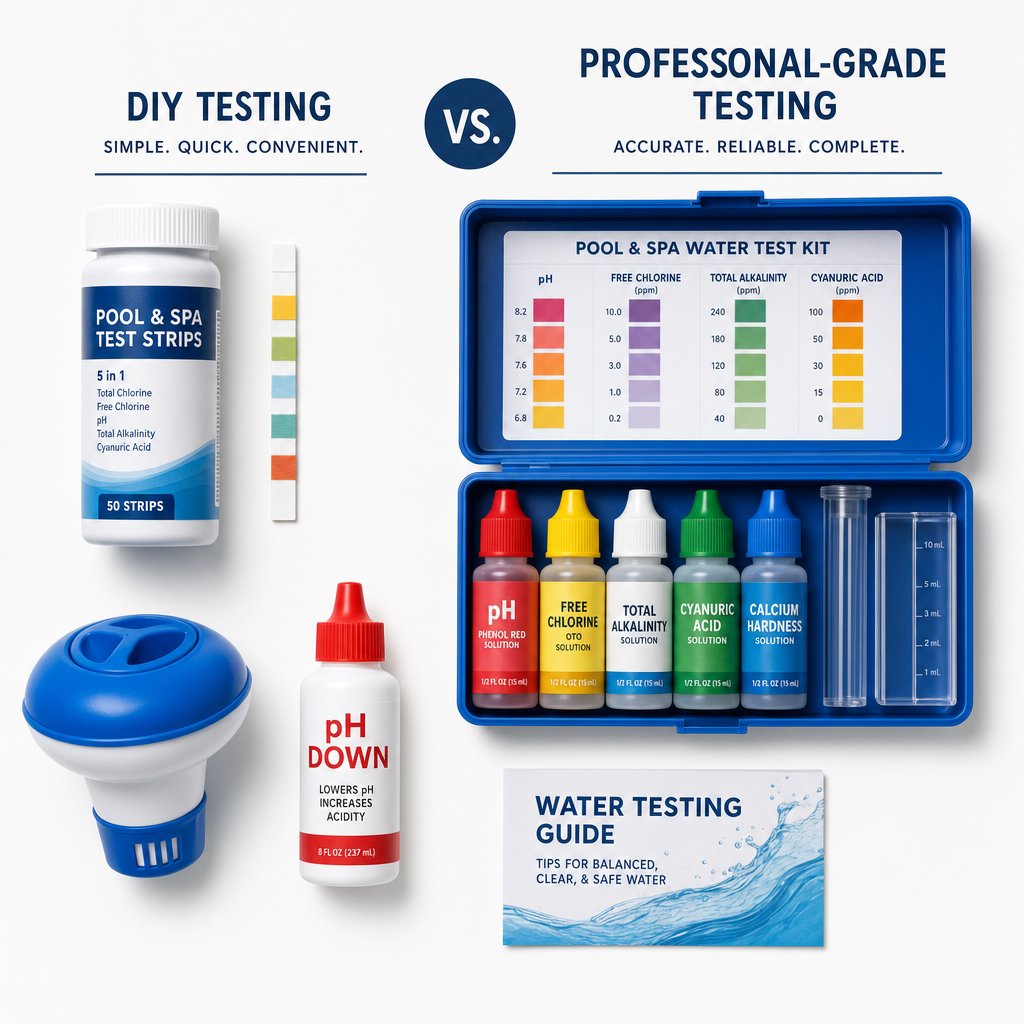
Pool maintenance sits in a strange place. On one hand, the basic tasks — skimming leaves, emptying baskets, brushing walls — are genuinely simple. On the other hand, the chemistry, equipment management, and Florida-specific challenges mean that "simple" doesn't always mean "do it yourself."
What DIY Pool Care Actually Looks Like
A realistic DIY pool maintenance routine in Tampa Bay involves:
- Daily or every-other-day: Skim surface debris, check water level
- 2–3x per week: Test water chemistry (pH, chlorine, alkalinity, stabilizer), add chemicals as needed
- Weekly: Brush walls and floor, clean skimmer and pump baskets, inspect filter pressure
- Monthly: Backwash or clean filter, shock the pool, inspect equipment
- Seasonally: Adjust chemical strategy for weather changes, inspect cover, check auto-chlorinator
That's 3–5 hours per week minimum. In peak summer (June–September), it's often more because the heat and sun demand more frequent chemical adjustments.
Where DIY Works Fine
- Skimming and basket cleaning. These are genuinely easy tasks that anyone can do. The real question is whether you'll do them consistently.
- Adding pre-measured chemicals. If you buy stabilized chlorine tabs and follow the label directions, you're not doing anything dangerous. The risk isn't in the adding — it's in the testing and judging how much you need.
- Basic brush and vacuum. Wall and floor brushing prevents algae attachment. Manual vacuuming is tedious but straightforward.
Where DIY Gets Expensive Fast
Chemistry mismanagement. This is where DIY pool owners lose money. Get your pH wrong and your chlorine stops working — you'll dump more and more chlorine into the water trying to compensate, burning through $60–$100/month instead of $30–$50. Get your stabilizer too high and your chlorine becomes nearly inert until you partially drain and refill the pool ($300–$800 in water cost).
Missing early equipment problems. A slightly unusual pump noise, a pressure reading that's creeping up, a heater that takes longer to ignite — these are all early warning signs. A professional tech hears and sees these daily. A DIY owner notices them when the pump fails at 2 AM in August and you have a $800 emergency call-out.
Algae blooms. Once algae takes hold in a Tampa Bay pool (and it will, in the summer heat), the recovery process is intensive: super-chlorination, algaecide treatments, aggressive brushing, filter running continuously, multiple water tests and adjustments over several days. A professional handles this routinely. A DIY owner often calls a professional during the algae bloom — which is exactly when service costs are highest.
The Tampa Bay Factor
Tampa Bay's climate makes DIY pool maintenance harder than the national average:
- UV index 9–11 in summer means chlorine burns off in hours, not days. You're testing and adjusting almost daily in peak season.
- Tropical storms can dump a pool full of fresh rainwater and debris in 30 minutes. You need to be able to respond quickly.
- Year-round operation means no "winterizing" break. Your pool demands attention 365 days a year.
- Sand and wind clog filters faster, requiring more frequent backwashing and cleaning.
The Real Cost Calculation
DIY annual cost:
- Chemicals: $500–$900 (higher if you make mistakes)
- Equipment wear from mismanagement: $200–$500/year in avoidable repairs
- Your time: 3–5 hours/week × 52 weeks = 156–260 hours
Professional service annual cost:
- Weekly service contract: $1,600–$3,000 (often includes chemicals)
- Your time: 15–30 minutes/week for check-ins
The time savings alone are significant. But the real value is expertise — someone who knows what Tampa Bay's weather is doing to your chemistry this week, who catches equipment wear before it becomes a failure, and who can respond to storm damage or algae blooms immediately.
Who Should DIY?
- You live nearby and can respond to pool issues within hours
- You enjoy the process and don't mind weekly time commitments
- You're comfortable reading test strips/drops and understanding what the numbers mean
- You're on a tight budget and can absorb occasional mistakes
Who Should Hire a Pro?
- You travel frequently or have an unpredictable schedule
- You've tried DIY and ended up with repeated algae blooms
- You have a salt system, automation, or complex equipment setup
- You value consistency and don't want to think about pool chemistry
- You're paying a mortgage on a home you want to protect (neglected pools damage property value)
For most Tampa Bay homeowners, professional service isn't an expense — it's insurance against far more expensive problems.