
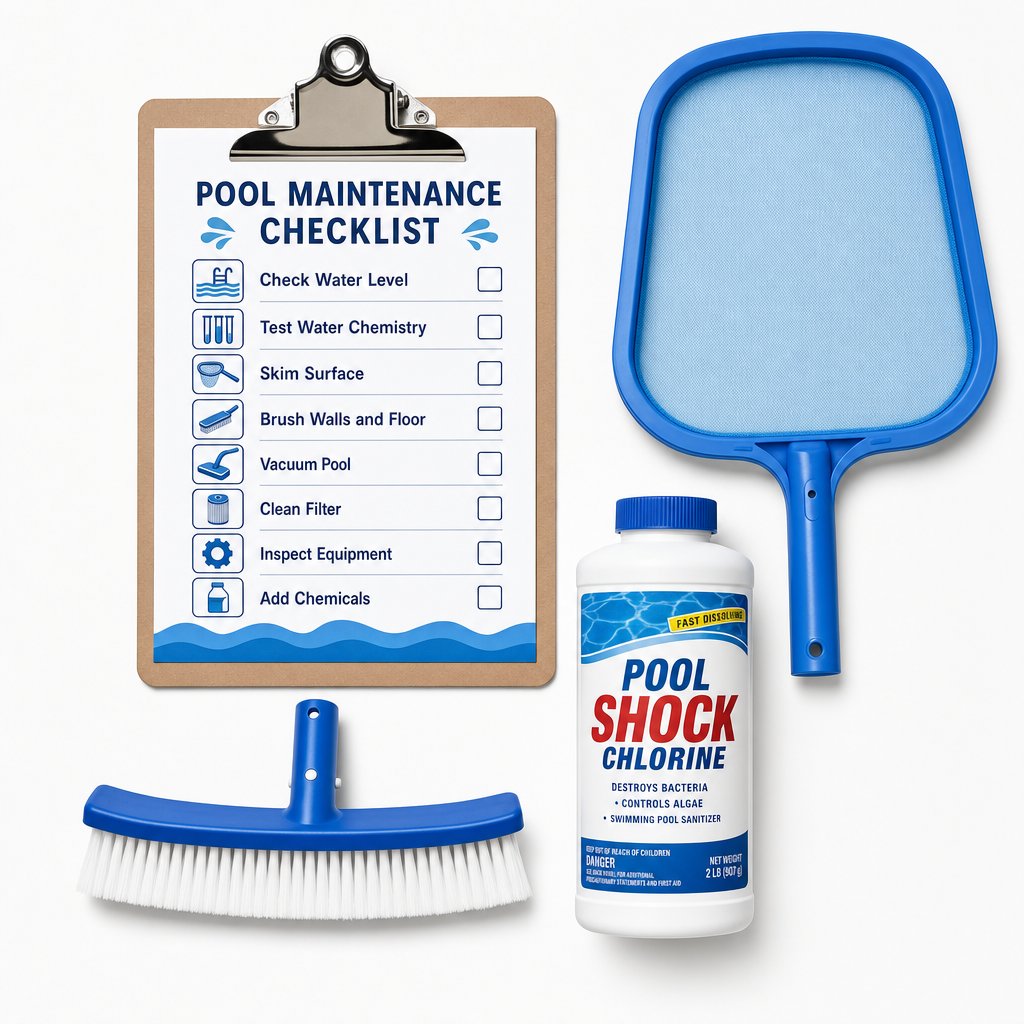
Whether you're managing your own pool or working with a service company, knowing what maintenance should happen — and when — helps you verify quality and catch problems early. This checklist covers everything from daily skimming to annual equipment inspections, tailored to Tampa Bay's specific climate challenges.
Daily Tasks
- Skim the surface. Remove leaves, insects, and any debris floating on top. In Tampa's wind season, this can be necessary twice a day.
- Check the water level. Should be at the middle of the skimmer opening. Too low and the pump draws air; too high and the skimmer can't effectively remove surface debris.
- Visual inspection. Look for anything unusual — cloudy water, floating algae, unusual equipment sounds, or chemical odors.
Every 2–3 Days
- Test the water. Use drop-test kits (not strips — they're inaccurate) for pH, alkalinity, and chlorine. In peak summer, test at least twice a week.
- Add chemicals as needed. Based on your test results, add chlorine, pH adjusters, or stabilizer. Never add multiple chemicals at the same time — space them at least 4 hours apart.
- Check the auto-chlorinator. Verify it's dispensing and the chemical level is adequate.
Weekly
- Brush walls and floor. Prevents algae attachment and distributes chemicals evenly. Use a pool brush appropriate for your surface (nylon for vinyl/fiberglass, wire for plaster).
- Clean skimmer and pump baskets. Empty and rinse both. Clogged baskets restrict flow and reduce filtration efficiency.
- Inspect the filter. Check the pressure gauge. If it's 8–10 psi above the clean reading, it's time to backwash (sand/DE) or clean (cartridge).
- Vacuum the pool. Even with an automatic cleaner, a manual vacuum pass catches debris the robot missed.
- Check the pool cover (if you use one). Remove debris, inspect for damage, and ensure it's secure.
Monthly
- Deep clean the filter. Backwash sand/DE filters thoroughly. Soak and rinse cartridge filters with a filter cleaner solution.
- Shock the pool. Super-chlorinate to break down chloramines (combined chlorine that causes odor and irritation). In Tampa Bay, shock at least monthly, more frequently after heavy use or storms.
- Inspect equipment. Listen for unusual pump noises, check for leaks around connections, verify heater ignition, and inspect the salt cell for calcium buildup.
- Test calcium hardness. Once a month is sufficient. Adjust if outside the 200–400 ppm range.
Seasonally
Spring (March–April):
- Full equipment inspection before peak season
- Clean or replace filter media
- Inspect and service the salt cell
- Verify heater operation
- Check all electrical connections
- Test the automatic feeder and refill
Summer (June–August):
- Increase chemical testing frequency (2–3x per week)
- Watch for algae blooms after storms
- Monitor stabilizer levels — may need partial drain if above 50 ppm
- Clean filter more frequently due to debris load
- Ensure pool cover is secure for storm season
Fall (September–November):
- Begin reducing pump runtime gradually
- Lower chlorine dosage
- Inspect and repair pool cover for winter
- Service equipment during lower-demand period
- Consider annual professional equipment inspection
Winter (December–February):
- Maintain at least minimal circulation (6–8 hours daily)
- Keep chlorine at low but effective levels
- Remove debris from cover regularly
- Monitor water chemistry monthly
- Plan spring opening procedures
After Every Storm
- Skim aggressively. Tropical storms dump massive debris loads.
- Test water immediately. Rain dilutes chemicals and throws off pH.
- Shock the pool. After any significant rain event, shock to handle the organic load.
- Check equipment. High winds can damage covers, knock over equipment, or dislodge pipes.
- Inspect for damage. Look for cracked tiles, displaced coping, damaged covers, or displaced equipment.
Annual Professional Inspection
At least once per year, have a professional pool technician perform a comprehensive inspection:
- Electrical safety check (GFCI testing, connection integrity)
- Pump and motor condition assessment
- Filter media condition and replacement needs
- Heater heat exchanger inspection
- Salt cell condition and output verification
- Auto-feeder calibration
- Safety equipment verification (drain covers, barriers)
- Plaster/surface condition assessment
This $150–$300 inspection can identify problems early enough to fix them cheaply, rather than discovering them when they've become emergencies.