
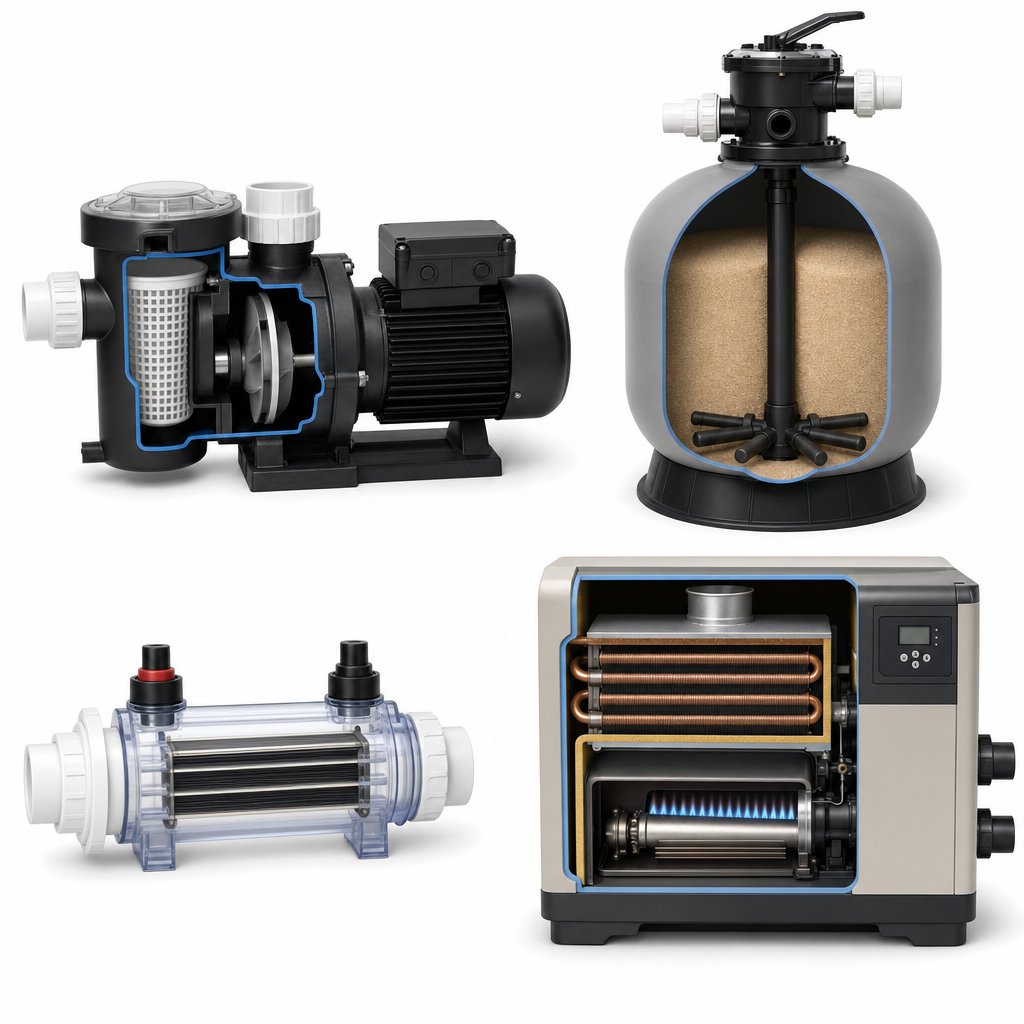
Your pool has a circulatory system, a filtration system, a sanitization system, and possibly a heating system. Understanding what each piece does, how long it lasts, and what failure sounds like saves you thousands in emergency repairs.
The Pool Pump: Your Pool's Heart
The pump circulates water through the filter and back to the pool. Without it, your pool is a stagnant pond.
Types:
- Single-speed: Runs at full speed always. Cheapest to buy, most expensive to operate. Consumes 2,500–3,500 watts.
- Dual-speed: Can run at high speed for filtration and low speed for circulation. Moderate upfront cost, moderate energy savings.
- Variable-speed: Runs at whatever speed is needed for the task. Most expensive upfront ($800–$1,500), but saves 50–80% on energy vs. single-speed.
Lifespan: 8–12 years for the motor. Bearings typically fail first, followed by seal leaks.
Replacement cost: $400–$1,200 installed, depending on horsepower and type.
Signs it's failing: Unusual noise (grinding or screeching), leaking seal (water weeping from the shaft), frequent breaker trips, or it simply won't start.
Tampa Bay tip: Variable-speed pumps are especially worthwhile in Florida because your pool runs year-round. The energy savings compound over 365 days of operation.
The Filter: Your Pool's Kidneys
Filters remove debris and microorganisms from the water. There are three main types:
Sand filters:
- Most common in Tampa Bay
- Backwash when pressure rises 8–10 psi above clean pressure
- Sand lasts 5–7 years before replacement ($100–$200 for a full change)
- Simple, reliable, but least effective at fine filtration
Cartridge filters:
- Better filtration than sand (catches smaller particles)
- Clean by hosing off the cartridge (no backwash water waste)
- Cartridges last 1–3 years ($50–$150 each)
- More maintenance-intensive but better water clarity
DE (Diatomaceous Earth) filters:
- Best filtration available
- Require DE powder addition and periodic grid cleaning
- More complex and expensive to maintain
- Less common in residential Tampa Bay pools
Lifespan: 10–15 years for the filter vessel. Sand, cartridges, or DE grids need periodic replacement.
Signs it's failing: Pressure won't drop after backwashing/cleaning, visible cracks in the tank, or persistent cloudy water despite proper chemical levels.
The Heater: Extending Your Swimming Season
Tampa Bay's climate means most pools don't need heating, but a heater extends your season by a few months in each direction and makes winter swimming comfortable.
Gas heaters (natural gas or propane):
- Heat fastest (can raise pool temperature 10°F in 2–4 hours)
- Highest operating cost ($1–$3 per hour of operation)
- Shortest lifespan: 10–15 years
- Best for occasional use and rapid heating
Heat pumps:
- 3–4x more energy-efficient than gas
- Slower heating (raises temperature 1–2°F per day)
- Longer lifespan: 15–20 years
- Best for Tampa Bay's climate — mild winters mean you don't need rapid heating
- Operating cost: $0.50–$1.50 per hour
Solar heaters:
- Lowest operating cost (sun is free)
- Most dependent on weather — limited effectiveness in cloudy/rainy periods
- Lifespan: 10–15 years for collectors
- Best as a supplement to a heat pump or gas heater
Replacement cost: $2,000–$3,500 installed, depending on type and size.
The Salt System: Chlorine Without the Tabs
Salt systems dissolve salt in your pool water and use an electrochemical process to produce chlorine continuously.
Components:
- Salt cell: The heart of the system. Passes current through the water to produce chlorine. Lasts 3–5 years ($300–$600 replacement).
- Control panel: Regulates chlorine output based on your settings. Lasts 8–12 years.
- Salt level sensor: Monitors dissolved salt concentration.
Salt consumption: 50–100 lbs of pool salt per year (costs $15–$30 per bag at a home center).
Signs it's failing: Low chlorine reading despite the system being on, visible calcium buildup on the cell plates, or error codes on the control panel.
Automatic Cleaners: Robots, Suction, and Pressure
Suction-side cleaners: Attach to a suction port, use water flow to navigate. Cheap ($200–$400) but slow and easily gets stuck.
Pressure-side cleaners: Attach to a booster pump, use water pressure to navigate. Better coverage ($400–$800) but require a dedicated booster pump.
Robotic cleaners: Self-contained units with their own pump and filter. Most effective ($800–$2,000), lowest maintenance on your pool equipment, but most expensive upfront.
Lifespan: 3–7 years depending on type and usage. Robotic cleaners typically last longest because they don't stress your pool's equipment.
Tampa Bay tip: With the amount of wind-blown debris in Tampa, an automatic cleaner is almost essential. The sand and leaves that get into your pool daily make manual vacuuming a full-day job.