
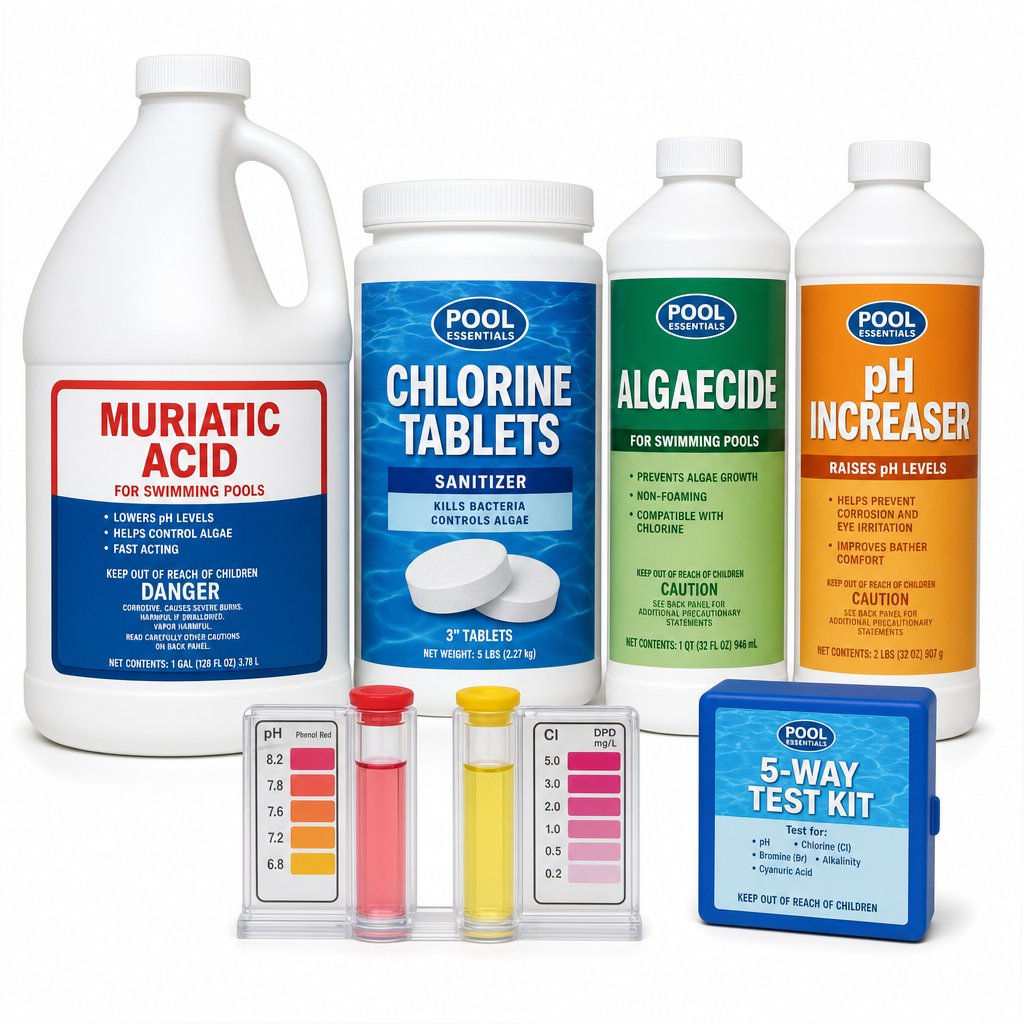
Pool chemistry sounds intimidating, but it really comes down to five numbers. Master these five, and you understand 90% of what's happening in your pool. The other 10% is equipment maintenance and knowing when to call a professional.
The Five Numbers That Matter
1. pH (Target: 7.4–7.6)
pH measures how acidic or basic your water is. It's the single most important number because it affects everything else:
- pH too low (<7.2): Water becomes corrosive. It eats at your pool equipment, irritates eyes and skin, and causes plaster etching.
- pH too high (>7.8): Water becomes scale-forming. Calcium deposits on walls, tiles, and equipment. Chlorine becomes less effective.
- The sweet spot (7.4–7.6): Comfortable for swimmers, optimal for chlorine performance, gentle on equipment.
In Tampa Bay, pH tends to run high because of the alkaline nature of local water supplies and the outgassing of CO2 in warm water. You'll likely be adding muriatic acid or sodium bisulfate regularly to bring it down.
2. Total Alkalinity (Target: 80–120 ppm)
Total alkalinity is your water's buffering capacity — its resistance to pH changes. Think of it as the shock absorber for your pH:
- Too low (<80): pH swings wildly. A rainstorm or a chemical addition can send pH shooting up or down, and you spend the rest of the day chasing it.
- Too high (>120): pH becomes stubborn. It won't come down easily, and you'll waste acid trying to correct it.
- The sweet spot (80–120): Stable pH, predictable chemical response.
Tampa Bay pool owners typically need to raise alkalinity initially (local water is often low in this) and then maintain it.
3. Calcium Hardness (Target: 200–400 ppm)
Calcium hardness prevents your water from becoming corrosive (which eats at plaster and grout) or scale-forming (which deposits calcium on surfaces).
- Too low (<200): Water becomes corrosive. Plaster surfaces become rough and pitted. Metal components corrode.
- Too high (>400): Scale forms on walls, tiles, equipment, and heating elements. Scale on your heater reduces efficiency and can cause premature failure.
- The sweet spot (200–400): Balanced water that protects both plaster and equipment.
Florida's water supply varies by county. Hillsborough County water tends to be moderately hard, which is usually in the right range. If you're using well water, test it — results can vary dramatically.
4. Stabilizer / Cyanuric Acid (Target: 30–50 ppm)
This is the number that matters most in Tampa Bay. Cyanuric acid is a sunscreen for your chlorine — it prevents UV light from destroying it.
- Too low (<30): Sun destroys your chlorine within hours. You're dumping money into the pool that evaporates before it can sanitize.
- Too high (>50): Chlorine becomes "locked" and ineffective. You can have plenty of chlorine reading on your test kit, but it's not actually sanitizing because the stabilizer is holding it back.
- The sweet spot (30–50): Enough UV protection without choking your chlorine.
In Tampa Bay, stabilizer builds up over time from using stabilized chlorine (tabs). Eventually it gets too high, and the only fix is to partially drain and refill the pool. This is a $300–$800 expense in water cost alone, so it's worth monitoring regularly.
5. Free Chlorine (Target: 1–3 ppm for non-salt, 3–5 ppm for salt systems)
Chlorine is your sanitizer — it kills bacteria, viruses, and algae. The target range depends on your chlorine source:
- Stabilized chlorine (tabs): 1–3 ppm free chlorine
- Salt water generator: 3–5 ppm (salt systems produce chlorine continuously, so the reading is higher)
- Liquid chlorine (shock): Temporary spike to 10+ ppm, then drops back to normal range
The Tampa Bay Chemical Challenge
Tampa Bay's climate creates unique chemical challenges:
The UV problem. With a summer UV index of 9–11, your chlorine is being destroyed at an accelerated rate. A pool in Minnesota might hold chlorine for days. A pool in Tampa might lose half its chlorine in a single sunny afternoon. This is why Tampa pool owners use more chemicals than almost anywhere else in the country.
The rain problem. Tropical storms dump enormous volumes of fresh rainwater into your pool, diluting all your chemicals at once. A single heavy storm can drop your chlorine from 3 ppm to under 1 ppm and throw your pH off by 0.5 points or more. You need to be ready to respond quickly.
The heat problem. Warm water accelerates everything — algae growth, chemical consumption, calcium scaling. A pool at 85°F uses chemicals faster than the same pool at 70°F.
Salt Water vs. Chlorine Tablets
Tampa Bay has seen a massive shift toward salt water systems in the last decade. Here's how they compare:
Salt systems:
- Produce chlorine continuously from dissolved salt
- Softer feeling water, less eye/skin irritation
- Lower ongoing chemical cost (salt is cheap)
- Salt cell replacement every 3–5 years ($300–$600)
- Requires more monitoring (salt level, cell condition, chlorinator output)
- Can corrode metal components if not properly balanced
Traditional chlorine tabs:
- Simple, proven technology
- No equipment to maintain beyond the dispenser
- Higher ongoing chemical cost
- Water can feel harsher (more chlorine taste/odor)
- Stabilizer builds up over time (requires periodic draining)
Both systems work. The right choice depends on your budget, willingness to monitor, and how much you value water comfort.